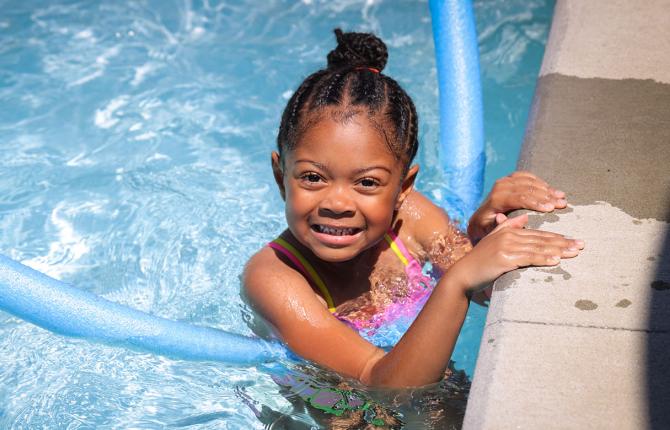
Keeping Swimmers Safe
Summer is here and YMCA indoor and outdoor pools are filled with kids and families. To ensure safety for everyone, we ask for your partnership in following our water safety rules.
“It’s really important for parents and members to understand and follow our rules about water safety, especially for non-swimmers,” says Summer Faircloth, director of risk management for the YMCA.
What is a Swim Assessment?
The assessment is designed to gauge a child’s swimming skills and comfort level.
The swim assessment allows us to consistently assign safe swimming areas based on swim abilities. Once assessed, swimmers wear a swim band indicating where they are allowed in the pool. Our purpose is for lifeguards to quickly identify a swimmer’s abilities by the colored band worn around his or her neck.
To help clearly provide boundaries and swimming areas for the swimmers, we observe their skills and assess their abilities.
Children age 13 and below can be assessed in order to earn a swim band. The first swim band is free, and replacement bands can be purchased for $3. Swimmers not wearing swim bands must use the shallow end of the pool. The lifeguard administering the test determines whether the swimmer has earned a band.
If the child is assessed as a non-swimmer, the the child must wear a United States Coast Guard approved life jacket.
Swim Bands
There are two levels of Swim Bands. The lifeguard administering the assessment determines whether the swimmer has earned a band.
YMCA swim assessments are given every day, usually during the hourly ten-minute break.
Swim assessments must be completed without the use of goggles.
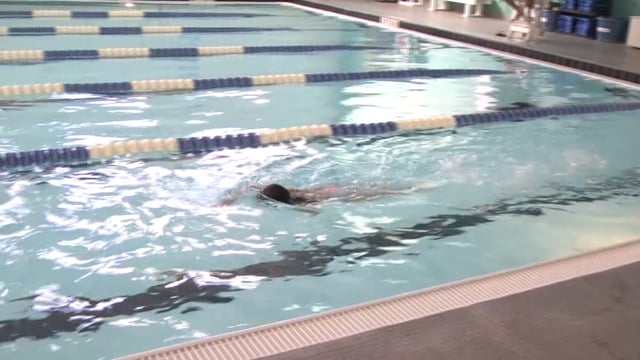
Swim Assessment Video
Watch this video to learn more about the YMCA Swim Assessment.
Reminders & Best Practices
The simplest rule is easy. If your child is a non-swimmer, meaning they have not taken the YMCA swim assessment, and do not have a swim band, they must wear a USCG-approved water floatation device (aka a life jacket) and the parent or guardian must have continuous visual contact with the child.
Continuous visual contact is important. It means you are paying attention and not constantly distracted by another activity.
If your child is not wearing a USCG-approved life jacket, then the parent or guardian must be in the water and within arms reach of the child at all times.
YMCA lifeguards are well-trained experts, and there is no better guard than you, the parent. You have your eyes on your children – we have our eyes on all the people in the pool.
Even if your older child is a good swimmer with a YMCA black band, it’s good practice to have eyes on your children any time they are in or around water. Even good swimmers get tired.
Each YMCA pool has our rules posted in or around the pool house. We also have a supply of life jackets, but we encourage you to bring your own.
YMCA swim assessments are given every day, usually during the hourly ten-minute break.
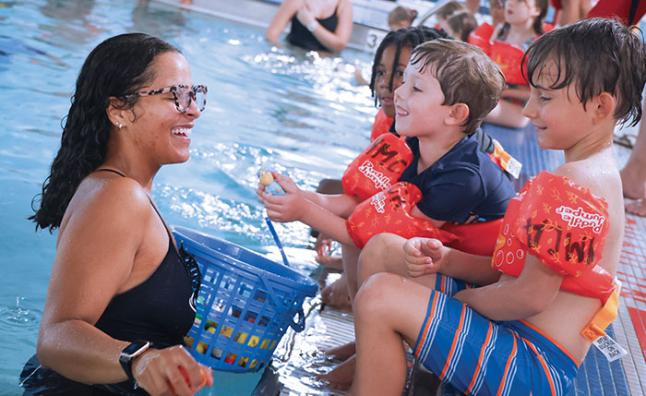
Swim Lessons
Learn to swim in a friendly, caring environment at the YMCA of the Triangle, where we have been teaching our community how to swim for more than 150 years. At the YMCA, our swim programs teach safety, skill and how to enjoy water activities for a lifetime.